



Jun 20, 2025
Please contact us
with corrections
or breaking news










Please contact us
with corrections
or breaking news
Predicting the Future Thru Film: The Cabinet of Doctor Caligari
by Doniphan Blair
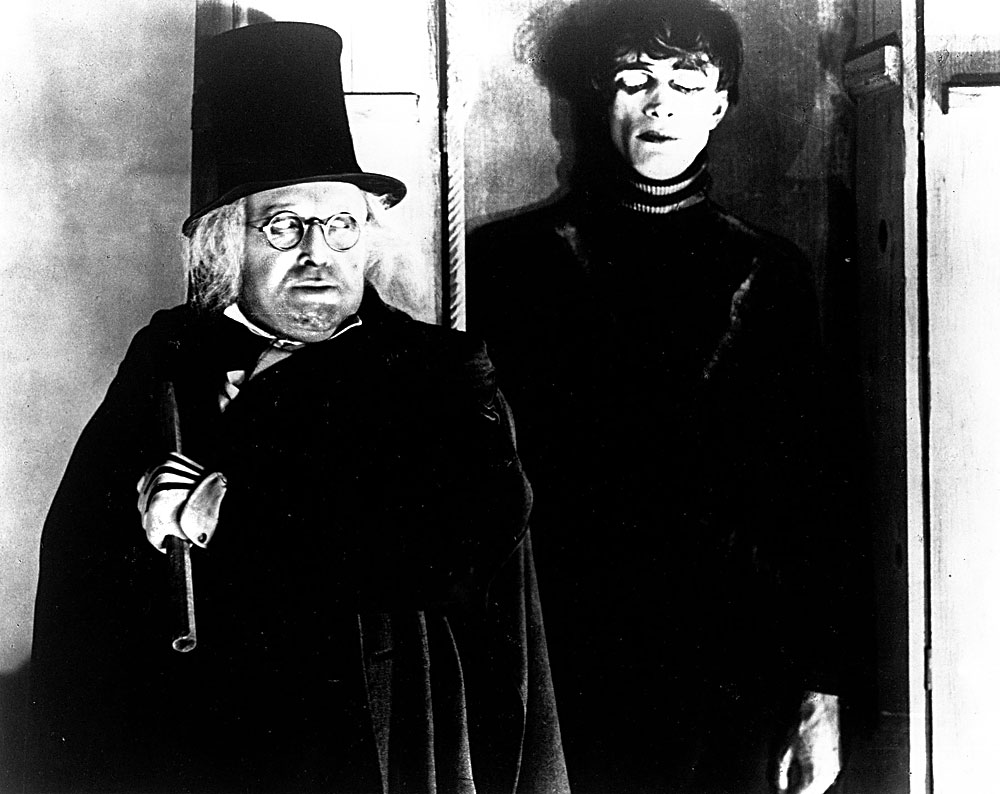 The eponymous Caligari, played by Werner Krauss, reveals his Frankenstein, or somnambulist, Cesare, played by Conrad Veidt, in the movie that broke all rules and even predicted Germany's Nazi future. photo: Decla-Bioscop StudiosFrom Caligari to Hitler: a Psychological History of German Film, Siegfried Kracauer, Princeton University, 1947, 331 pp, used from $13.00.
"The Cabinet of Doctor Caligari," Robert Wiene’s 1920 silent classic, can be tough sledding for those raised on quick cuts and surround-sound, especially if forced to view it in a 9:00 am film history class. Some interest will undoubtedly be sparked by the hallucinatory visuals, the mystical overtones and sex-death motif, but students may still doubt the professor’s claim that, "'Caligari' is one of the greatest films of all time!"
In defense of this hyperbole, however, allow me to refer you to "From Caligari to Hitler," Siegfried Kracauer's brilliant exegesis. Not only is "Caligari" a masterpiece, according to Kracauer, a German-Jewish writer and social critic who lived through that period, before escaping to Paris, it is a tour de force collaboration of art and commerce. And it broke ground in horror, expressionism, faulty narrators and twist endings.
It also predicted its audience's future by palpating their psyche. Essentially a Rorschach test of the German mind, "Caligari" told the rise-of-Nazism story with Hitler as the Caligari figure, the head doctor of the insane asylum, where the film is set, and the passive German people as the somnambulist Cesare, the man kept in the titular "cabinet." Meanwhile, the failure of Germany’s intellectuals is portrayed through the protagonist Francis.
“The films of a nation reflect its mentality in a more direct way then other artistic media,” claimed Kracauer. “First, films are never the product of an individual... Second, films address themselves, and appeal, to the anonymous multitude... What films reflect are not so much explicit credos as psychological dispositions."
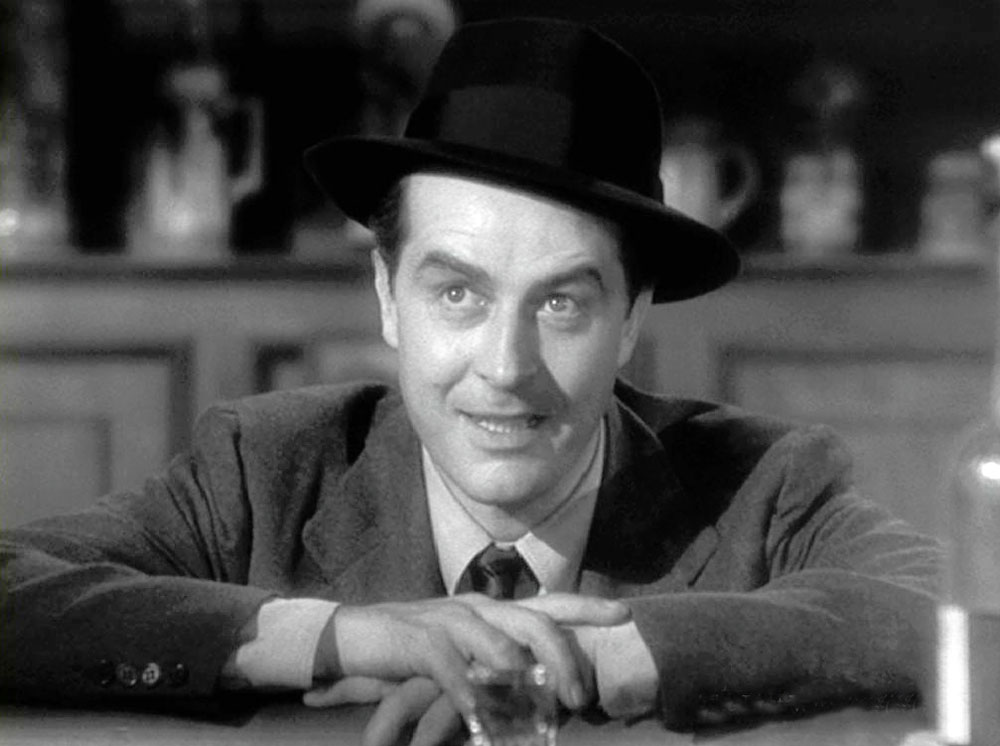 Seigfried Kracauer was a Frankfurt Jew and critic, which uniquely enabled him to understand the post-modern, mass psychology origins of Nazism. photo: circa 1945 Kracauer collectionPublished in 1947, "From Caligari to Hitler" came a tad early after the war for such an ambitious zeitgeist review, prefiguring postmodernism and Marshall McLuhan, although Kracauer was phenomenally well-trained for the task.
As a Frankfurt Jew, he spent the Swinging '20s, which swung like hell there, as Frankfurt’s leading editor and critic, with a special interest in film. Cinema exploded in Germany following World War I, because the war delayed the new art's introduction, while increasing entertainment demand. Indeed, Kracauer was a friend and mentor of the famous Jewish-German philosopher, Theodor Odorno, and worked alongside another literary luminary, Walter Benjamin.
Very much their equals, Kracauer authored the well-received studies "The Detective Story," "The Mass Ornament" and "The Salaried Masses," based on his innovative new take on circuses, advertising, and city layout, as well as film. With the rise of the Nazis in 1933, Kracauer moved to Paris, and then to New York, in 1941, where he worked at the Museum of Modern Art and received a Guggenheim scholarship.
"Films particularly suggestive of mass desires coincide with outstanding box-office successes," is Kracauer's most incredible revelation. In this way, a successful film does indeed becomes a Rorshach test. Although "Caligari' was not that successful initially in Germany, it is a point well taken today, no matter how much overly-intellectual critics may ridicule mass market fare.
Kracauer continues with a trenchant critique of our understanding of the true magic of cinema: "That most historians neglect the psychological factor is demonstrated by striking gaps in our knowledge of German history from World War I to Hitler’s ultimate triumph... Thus behind the overt history of economic shifts, social exigencies, and political machinations runs a secret history [of the culture]."
"The disclosure of these dispositions through the medium of the German screen may help in the understanding of Hitler’s ascent and ascendancy.” Certainly, the artistry of Leni Riefenstahl put the Nazi essence on display, but the entire gamut of German cinema did similar for the German people as a whole.
 Lil Dagover played Jane, 'Caligari''s love interest and kidnap victim, at the height of her lascivious powers before the Hayes Laws or Puritan propriety could clamp down on the visual sex of cinema. photo: Decla-Bioscop StudiosGermany missed the first big wave of film that swept America and the Allies in the teens because it was mired in the trenches of World War I. But, upon return to an uneasy peace, Germans reveled in the new entertainment, flocking to the hundreds of theaters which German entrepreneurs were opening.
Of all the arts, film is a full blown industry, hence, a likely place for venture capital. But how best to profit from the consumer’s obviously intense desires?
UFA (Universum-Film Aktiengesellschaft), the Weimar Republic’s massive studio, grew out of a wartime propaganda department and was supported by Erich Ludendorff, a decorated German generalwho became a vicious nationalist leader and advocate of the Stab-in-the-Back myth. Within a few years, UFA was turning out over 500 films annually. At the war's end, many impresarios read the large graffiti on the wall and jumped into producing films or founded their own smaller studios, soon leading to over two hundred in Berlin alone.
Their market research informed them, as Kracauer noted, that Germans were attracted to romantic, mystical and dark stories—it was the time of Freud, Dadaists and the "War to End all Wars," after all. Within two years of the war's end, on the eleventh hour of the eleventh day of the eleventh month of 1918, this explosive interface of capitalism and art allowed the medium-sized Decla-Bioscop studio to produce "Caligari," an acme of cinematic arts.
Ironically, it was a blatantly commercial project, intended to crack the lucrative and artier French and American markets. But its poetic pedigree was also monumental.
One co-author, Hans Janowitz, was an actual radical poet from Prague while the other, Carl Mayer, was a fallen aristocrat, disowned as a teen for blowing a fortune at Monte Carlo. Mayer ended up working the streets, selling trinkets and acting in peasant theater. "Caligari", while highly folkloric and archetypal, is also highly autobiographical, as it happened, drawn from lives and interests of Janowitz and Mayer.
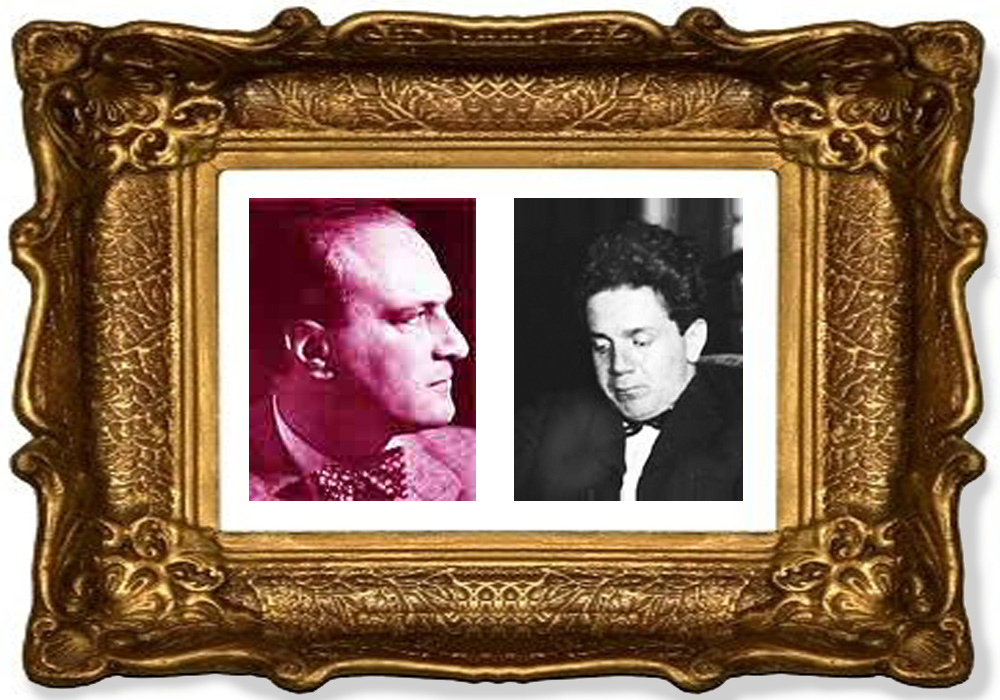 The authors of 'Caligari' were Hans Janowitz (left), a radical poet from Prague, and Carl Mayer, a fallen aristocrat who worked the street as a circus performer, among other occupations. photo: WikipediaApparently, Mayer had a bad experience with a psychiatrist his family sent him to, while Janowitz once pursued a beautiful young woman at a fair, only to lose her in the crowd. When he learned the next day she had been brutally murdered, he ran to tell his friend Mayer and they immediately began the first draft of 'Caligari.'. Later, they visited another fair, featuring a hypnotic strong man and adding another of "Caligari"'s story elements.
The narrative follows Francis, a young man, who sees a barker at a country fair manipulating a somnambulist, a person in a catatonic state. Later, his best friend is murdered under spooky circumstances and he suspects the carney barker, whom he follows to a nearby insane asylum.
Francis is astonished to discover that the barker is, in point of fact, the institution’s director, who is using a deranged patient as the somnambulist. A closer parable portraying Hitler and his adoring audience could not be found.
The word "cabinet" of the film’s title refers to the coffin-like box where the somnambulist sleeps. According to the film's made-up history, the head psychiatrist is researching Caligari, an 18th-century medium, to glean methods for committing the perfect crime. While the somnambulist does his murderous bidding, he places a wax figure in the cabinet, thereby obtaining an alibi for the police.
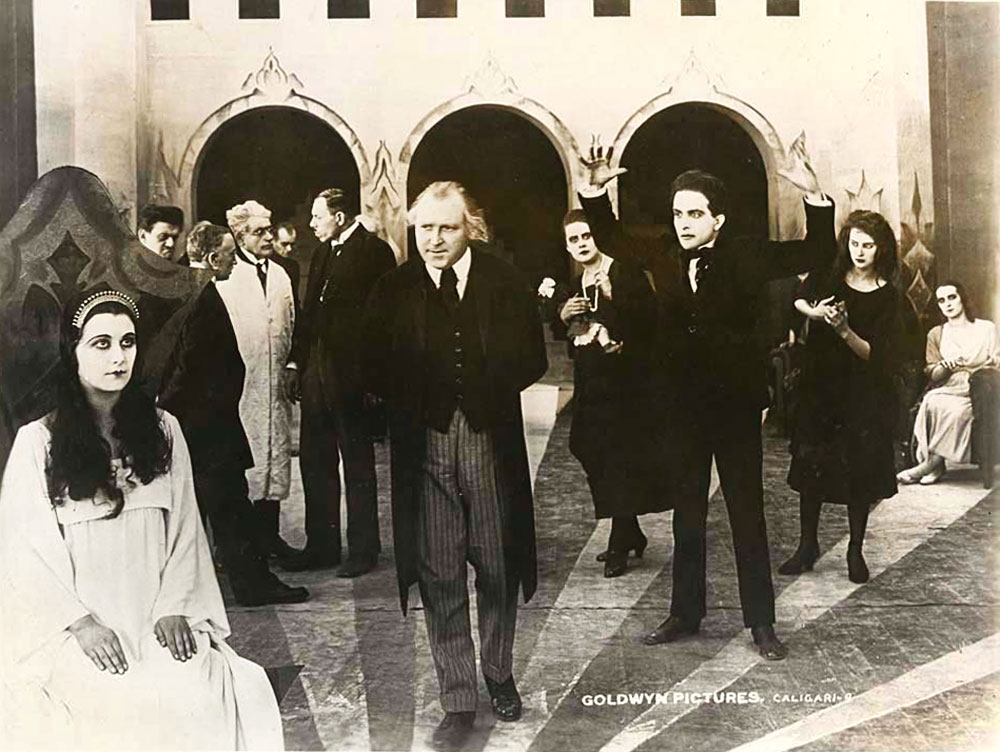 'Caligari' had a happy ending but not the pacifist, anti-authoritarian romantic one its author's wanted. Here, after Caligari is revealed to be the head doctor of the asylum, the film ends with him walking among the inmates. photo: Decla-Bioscop StudiosAnother twist is that the original screenplay had a happy ending: Francis exposes the evil doctor, who is arrested, and impresses the father of the girl he fancies, resolving the romantic's classical quest against authority and for love. This was in keeping with Janowitz’s feeling that “the authority that sent millions of men to their death... was bad in itself.”
What Erich Pommer, the head of Decla-Bioscop, saw in this subversive screenplay is not known but he bought it and assigned it to his top director, the talented Fritz Lang, soon to become famous for "Metropolis" (1927) and many more. Too bogged down with other projects, Lang passed the script to Robert Wiene, yet another perfect artistic collaborator, given he was the son of a famous, albeit utterly insane, Dresden actor.
Wiene followed Lang’s script suggestions but then rewrote it significantly, meaning the Mayer-Janowitz story enjoyed the going over of two significant talents. Indeed, Wiene added the critical "framing story," which turned Francis into the faulty narrator, who is already in the asylum at the beginning of the film—a significant point revealed in flash back.
Indeed, by the end of the film is no longer the crazed doctor who is exposed and arrested, as viewers had been led to hope, but Francis who is seized and straight-jacketed. Completely reversing the story’s moral, Wiene's rewrite brought outraged protest from Janowitz and Mayer.
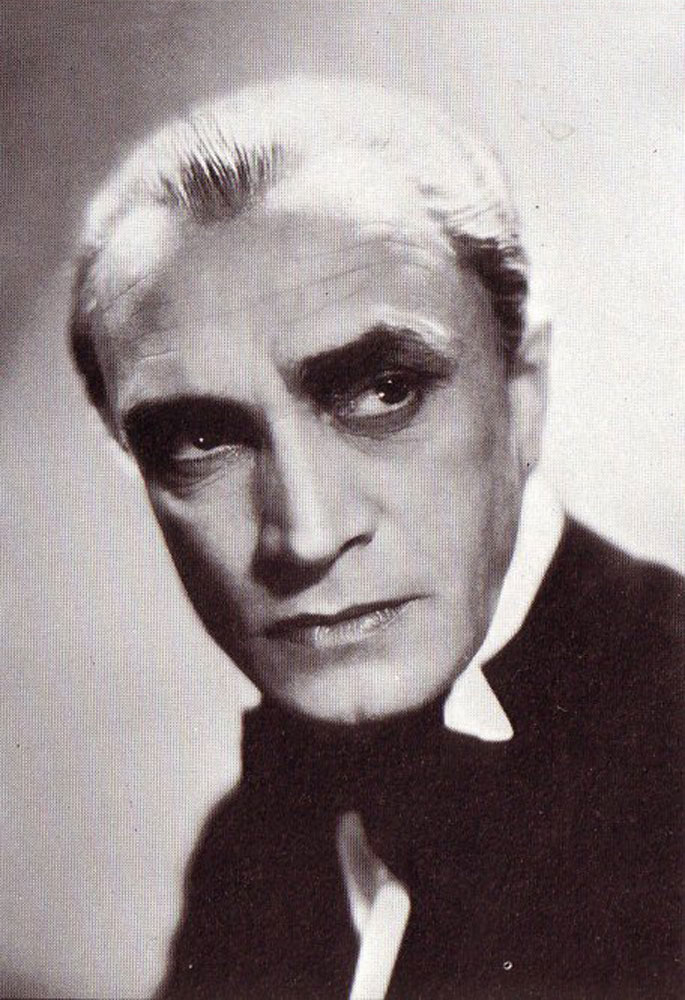 Robert Wiene, from a crazed theater family himself, went on to direct dozens more features but none nearing the impact of 'Caligari,' his first. photo: Decla-Bioscop StudiosWhat they couldn't realize is that the professional Lang's and Wiene canny audience understanding would make their self-absorbed story more palatable to a wider audience. In addition, instead of simply preaching against the "good German," it parodied them and prefigured the position of average citizens who awoke one morning fifteen years later to find that Nazis lunatics were running the asylum.
Unfolding like an onion, with layers of meaning, the viewer was obliged themselves to decide who was crazy.
Wiene hired three Expressionist painters—one was Hermann Warm, who felt that “films must be drawings brought to life”—to fit the set design to the script themes. Add "Caligari"'s great acting, you have a cinematic juggernaut.
The world would have done well to study German cinema a bit closer in the interbellum period, Kracauer advises us. Conversely, Decla-Bioscop’s creation of such a psychologically-keyed masterpiece testifies to the potential of an art/industry, rational/romantic partnership, as a way of finding narratives at the advanced edge of the public's dream structure and thereby both reflecting and influencing it.
Kracauer goes on to detail all the cinema art movements and market perturbations in Germany during the '20s and '30s—events that both reflected and effected the German zeitgeist at the time. He concludes with a chilling survey of Leni Riefenstahl, notably her artistically great but narratively perverse "Triumph of the Will" (1938), and of Nazi propaganda minister Josef Goebbels.
About Goebbels, Kracauer notes: “He rejected ‘power based on guns,’ because power that fails to invade and conquer the soul is faced with ever impending revolution... propaganda has ‘to win the heart of the people and keep it’... thus confirm[ing] that Nazi propaganda drew upon all the capacities of the people to cover the void it created.”
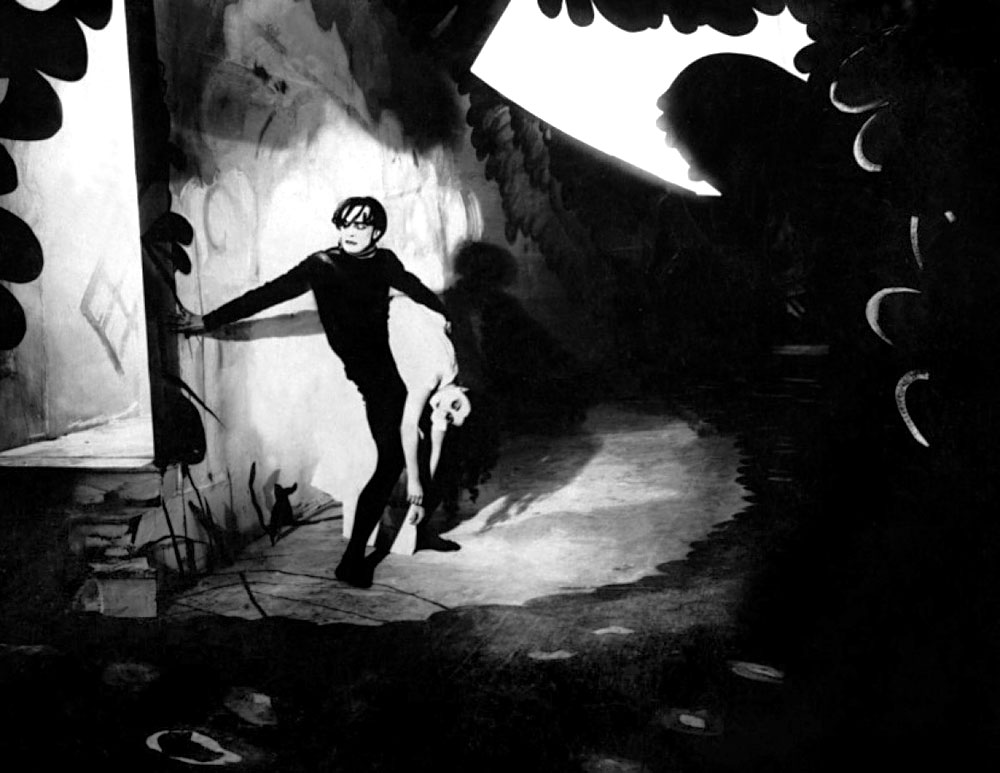 In a psychedelicized scene of stupefying proportions, the somnambulist Cesare carries off Jane, but it was not enough to inform Germans' of the impending kidnapping of their country by Uncle Adolph. photo: Decla-Bioscop Studios Like Hitler, Goebbels was a failed artist, although his well-received modern novel of ideas, "Michael: A German Destiny in Diary Form" (1929) had seventeen printings, much more successful then his boss' paintings. Abandoning literature, he tried to put narrative magic-making at the service of a machine devoid of soul, a contradiction in terms.
"Caligari" is the pinnacle of the German Expressionist cinema that Goebbels tried to cannibalize, although, over the long run, it rose above and critiqued him. The film continues to cast its spell, from "Catcher in the Rye" (1951), where Holden Caulfield is found in a mental institution at book’s end, to "Dr. Strangelove" (1964), where similar horrific themes were farced up into tragicomedy.
This can lead one to wonder why today's studios, with all their market research and high-paid talent, can’t more efficiently find and fund bright-line but deep psychological narratives. Although we’ll only know for sure in a couple of decades, it seems the art/industry balance is broken and Hollywood lacks the experiment and enthusiasm that pervaded the German film industry in the '20s.
As Kracauer emphasizes, narrative—what it means, how it works and what it can achieve—is of vital importance to the human family, whether used for ill or good. Certainly, new narratives are needed in dealing with the Middle East or right here in the Bay Area, where Oakland is begging for the next iteration of John Singleton’s masterful "Boyz N the Hood" (1991).
But to find such spectacular new narratives and to get them to their audience requires all the vision and technical acumen of master film warriors—a noble challenge that just might wake up groggy early-morning film students today, particularly if they get to see "Caligari" with Kracauer’s book—or a teacher familiar with the text—close at hand.
Posted on Sep 04, 2008 - 08:46 PM
by Doniphan Blair
The eponymous Caligari, played by Werner Krauss, reveals his Frankenstein, or somnambulist, Cesare, played by Conrad Veidt, in the movie that broke all rules and even predicted Germany's Nazi future. photo: Decla-Bioscop Studios"The Cabinet of Doctor Caligari," Robert Wiene’s 1920 silent classic, can be tough sledding for those raised on quick cuts and surround-sound, especially if forced to view it in a 9:00 am film history class. Some interest will undoubtedly be sparked by the hallucinatory visuals, the mystical overtones and sex-death motif, but students may still doubt the professor’s claim that, "'Caligari' is one of the greatest films of all time!"
In defense of this hyperbole, however, allow me to refer you to "From Caligari to Hitler," Siegfried Kracauer's brilliant exegesis. Not only is "Caligari" a masterpiece, according to Kracauer, a German-Jewish writer and social critic who lived through that period, before escaping to Paris, it is a tour de force collaboration of art and commerce. And it broke ground in horror, expressionism, faulty narrators and twist endings.
It also predicted its audience's future by palpating their psyche. Essentially a Rorschach test of the German mind, "Caligari" told the rise-of-Nazism story with Hitler as the Caligari figure, the head doctor of the insane asylum, where the film is set, and the passive German people as the somnambulist Cesare, the man kept in the titular "cabinet." Meanwhile, the failure of Germany’s intellectuals is portrayed through the protagonist Francis.
“The films of a nation reflect its mentality in a more direct way then other artistic media,” claimed Kracauer. “First, films are never the product of an individual... Second, films address themselves, and appeal, to the anonymous multitude... What films reflect are not so much explicit credos as psychological dispositions."
Seigfried Kracauer was a Frankfurt Jew and critic, which uniquely enabled him to understand the post-modern, mass psychology origins of Nazism. photo: circa 1945 Kracauer collectionAs a Frankfurt Jew, he spent the Swinging '20s, which swung like hell there, as Frankfurt’s leading editor and critic, with a special interest in film. Cinema exploded in Germany following World War I, because the war delayed the new art's introduction, while increasing entertainment demand. Indeed, Kracauer was a friend and mentor of the famous Jewish-German philosopher, Theodor Odorno, and worked alongside another literary luminary, Walter Benjamin.
Very much their equals, Kracauer authored the well-received studies "The Detective Story," "The Mass Ornament" and "The Salaried Masses," based on his innovative new take on circuses, advertising, and city layout, as well as film. With the rise of the Nazis in 1933, Kracauer moved to Paris, and then to New York, in 1941, where he worked at the Museum of Modern Art and received a Guggenheim scholarship.
"Films particularly suggestive of mass desires coincide with outstanding box-office successes," is Kracauer's most incredible revelation. In this way, a successful film does indeed becomes a Rorshach test. Although "Caligari' was not that successful initially in Germany, it is a point well taken today, no matter how much overly-intellectual critics may ridicule mass market fare.
Kracauer continues with a trenchant critique of our understanding of the true magic of cinema: "That most historians neglect the psychological factor is demonstrated by striking gaps in our knowledge of German history from World War I to Hitler’s ultimate triumph... Thus behind the overt history of economic shifts, social exigencies, and political machinations runs a secret history [of the culture]."
"The disclosure of these dispositions through the medium of the German screen may help in the understanding of Hitler’s ascent and ascendancy.” Certainly, the artistry of Leni Riefenstahl put the Nazi essence on display, but the entire gamut of German cinema did similar for the German people as a whole.
Lil Dagover played Jane, 'Caligari''s love interest and kidnap victim, at the height of her lascivious powers before the Hayes Laws or Puritan propriety could clamp down on the visual sex of cinema. photo: Decla-Bioscop StudiosOf all the arts, film is a full blown industry, hence, a likely place for venture capital. But how best to profit from the consumer’s obviously intense desires?
UFA (Universum-Film Aktiengesellschaft), the Weimar Republic’s massive studio, grew out of a wartime propaganda department and was supported by Erich Ludendorff, a decorated German generalwho became a vicious nationalist leader and advocate of the Stab-in-the-Back myth. Within a few years, UFA was turning out over 500 films annually. At the war's end, many impresarios read the large graffiti on the wall and jumped into producing films or founded their own smaller studios, soon leading to over two hundred in Berlin alone.
Their market research informed them, as Kracauer noted, that Germans were attracted to romantic, mystical and dark stories—it was the time of Freud, Dadaists and the "War to End all Wars," after all. Within two years of the war's end, on the eleventh hour of the eleventh day of the eleventh month of 1918, this explosive interface of capitalism and art allowed the medium-sized Decla-Bioscop studio to produce "Caligari," an acme of cinematic arts.
Ironically, it was a blatantly commercial project, intended to crack the lucrative and artier French and American markets. But its poetic pedigree was also monumental.
One co-author, Hans Janowitz, was an actual radical poet from Prague while the other, Carl Mayer, was a fallen aristocrat, disowned as a teen for blowing a fortune at Monte Carlo. Mayer ended up working the streets, selling trinkets and acting in peasant theater. "Caligari", while highly folkloric and archetypal, is also highly autobiographical, as it happened, drawn from lives and interests of Janowitz and Mayer.
The authors of 'Caligari' were Hans Janowitz (left), a radical poet from Prague, and Carl Mayer, a fallen aristocrat who worked the street as a circus performer, among other occupations. photo: WikipediaThe narrative follows Francis, a young man, who sees a barker at a country fair manipulating a somnambulist, a person in a catatonic state. Later, his best friend is murdered under spooky circumstances and he suspects the carney barker, whom he follows to a nearby insane asylum.
Francis is astonished to discover that the barker is, in point of fact, the institution’s director, who is using a deranged patient as the somnambulist. A closer parable portraying Hitler and his adoring audience could not be found.
The word "cabinet" of the film’s title refers to the coffin-like box where the somnambulist sleeps. According to the film's made-up history, the head psychiatrist is researching Caligari, an 18th-century medium, to glean methods for committing the perfect crime. While the somnambulist does his murderous bidding, he places a wax figure in the cabinet, thereby obtaining an alibi for the police.
'Caligari' had a happy ending but not the pacifist, anti-authoritarian romantic one its author's wanted. Here, after Caligari is revealed to be the head doctor of the asylum, the film ends with him walking among the inmates. photo: Decla-Bioscop StudiosWhat Erich Pommer, the head of Decla-Bioscop, saw in this subversive screenplay is not known but he bought it and assigned it to his top director, the talented Fritz Lang, soon to become famous for "Metropolis" (1927) and many more. Too bogged down with other projects, Lang passed the script to Robert Wiene, yet another perfect artistic collaborator, given he was the son of a famous, albeit utterly insane, Dresden actor.
Wiene followed Lang’s script suggestions but then rewrote it significantly, meaning the Mayer-Janowitz story enjoyed the going over of two significant talents. Indeed, Wiene added the critical "framing story," which turned Francis into the faulty narrator, who is already in the asylum at the beginning of the film—a significant point revealed in flash back.
Indeed, by the end of the film is no longer the crazed doctor who is exposed and arrested, as viewers had been led to hope, but Francis who is seized and straight-jacketed. Completely reversing the story’s moral, Wiene's rewrite brought outraged protest from Janowitz and Mayer.
Robert Wiene, from a crazed theater family himself, went on to direct dozens more features but none nearing the impact of 'Caligari,' his first. photo: Decla-Bioscop StudiosUnfolding like an onion, with layers of meaning, the viewer was obliged themselves to decide who was crazy.
Wiene hired three Expressionist painters—one was Hermann Warm, who felt that “films must be drawings brought to life”—to fit the set design to the script themes. Add "Caligari"'s great acting, you have a cinematic juggernaut.
The world would have done well to study German cinema a bit closer in the interbellum period, Kracauer advises us. Conversely, Decla-Bioscop’s creation of such a psychologically-keyed masterpiece testifies to the potential of an art/industry, rational/romantic partnership, as a way of finding narratives at the advanced edge of the public's dream structure and thereby both reflecting and influencing it.
Kracauer goes on to detail all the cinema art movements and market perturbations in Germany during the '20s and '30s—events that both reflected and effected the German zeitgeist at the time. He concludes with a chilling survey of Leni Riefenstahl, notably her artistically great but narratively perverse "Triumph of the Will" (1938), and of Nazi propaganda minister Josef Goebbels.
About Goebbels, Kracauer notes: “He rejected ‘power based on guns,’ because power that fails to invade and conquer the soul is faced with ever impending revolution... propaganda has ‘to win the heart of the people and keep it’... thus confirm[ing] that Nazi propaganda drew upon all the capacities of the people to cover the void it created.”
In a psychedelicized scene of stupefying proportions, the somnambulist Cesare carries off Jane, but it was not enough to inform Germans' of the impending kidnapping of their country by Uncle Adolph. photo: Decla-Bioscop Studios "Caligari" is the pinnacle of the German Expressionist cinema that Goebbels tried to cannibalize, although, over the long run, it rose above and critiqued him. The film continues to cast its spell, from "Catcher in the Rye" (1951), where Holden Caulfield is found in a mental institution at book’s end, to "Dr. Strangelove" (1964), where similar horrific themes were farced up into tragicomedy.
This can lead one to wonder why today's studios, with all their market research and high-paid talent, can’t more efficiently find and fund bright-line but deep psychological narratives. Although we’ll only know for sure in a couple of decades, it seems the art/industry balance is broken and Hollywood lacks the experiment and enthusiasm that pervaded the German film industry in the '20s.
As Kracauer emphasizes, narrative—what it means, how it works and what it can achieve—is of vital importance to the human family, whether used for ill or good. Certainly, new narratives are needed in dealing with the Middle East or right here in the Bay Area, where Oakland is begging for the next iteration of John Singleton’s masterful "Boyz N the Hood" (1991).
But to find such spectacular new narratives and to get them to their audience requires all the vision and technical acumen of master film warriors—a noble challenge that just might wake up groggy early-morning film students today, particularly if they get to see "Caligari" with Kracauer’s book—or a teacher familiar with the text—close at hand.
Posted on Sep 04, 2008 - 08:46 PM